Friday, November 13, 2009
We cannot bear the responsibility of allowing the destruction of the four great rivers
[Editorial] We cannot bear the responsibility of allowing the destruction of the four great rivers
The Hankyoreh
Posted on : Nov.10,2009 12:04 KST Modified on : Nov.10,2009 12:06 KST
The Four Rivers Restoration Project begins in earnest today. The construction is to begin immediately, after seemingly waiting for the findings of the Ministry of Environment‘s (MOE) environmental impact assessment. All sorts of concerns about reductions in water quality and destruction of the environment were completely ignored. It appears it is impossible to hope for any more rational discussion with an administration that remains obstinate about pushing the project.
Just imagining the effects of executing the Four Rivers Restoration Project as planned is horrible. Instead of flowing, river water will rot as it is trapped behind dams and weirs, while the wildlife growing on the riverbanks will die under dikes of concrete. Most of the aquatic ecology will be destroyed as river floors are dredged, and it is clear that the terrace land by the four rivers will be suffocated underneath cement as 1,700 kilometers of bicycle routes are built. Indiscriminate developmentalists are mangling our four main rivers, the Han, Nakdong, Guem and the Youngsan, which should be wholly preserved and bequeathed to our descendants.
The greatest responsibility for the Four Rivers Restoration Project coming to this point lays with President Lee Myung-bak. He is using his success with the Cheonggyecheon restoration project accomplished during his time as Seoul mayor to push forward this project. The restoration of the Cheonggyecheon, no more than a neighborhood stream, and the restoration of the four great rivers that feed the lands of southern Korea, are incomparable matters. The aim to complete this project that will cost taxpayers an estimated 20 trillion Won in just two to three years is nothing more than an act of greed intent on achieving a project of scale during his term. The four rivers are about to be destroyed as a result of President Lee’s egoism that stems from ignorance about the environment.
Minister of Land, Transport and Maritime Affairs Chung Jong-hwan and Environment Minister Lee Maan-ee will be unable to escape historical responsibility as accessories to the destruction of the four rivers. Chung, who styles himself a “Little MB” to a sickening extent, has been pushing the Four Rivers Restoration Project using all sorts of expedients and illegalities. In particular, Lee, by tacitly approving the environmental destruction caused by the Four Rivers project, has abandoned his role as Environment Minister. He will be recorded as a blot on South Korea’s history of environmental policy.
At any rate, construction for the Four Rivers Restoration Project commences today. It will soon be revealed just how much the four rivers will be destroyed as a result. We cannot just standby and watch it happen. To do so is ultimately no different than participating in the destruction of the four rivers. For this reason, just as the full-scale launch of the Four Rivers Restoration Project takes place today, so must the launch of a full-scale fight to save our four great rivers.
Wednesday, November 11, 2009
South Korea approved 11 new coastal reclamation projects
As you can see from the table above, some of the public waters and coastal wetlands will be reclaimed to provide lands for private investors and developers such as shipbuilding and energy companies. Because they can possess the land formed by reclaiming public waters and tidal flats, many South Korean companies want to reclaim coastal areas for their own economic benefits.
The natural environment of the Garorim Bay will be affected severely due to the new reclamation project linked to the Garorim Bay Tidal Power Project, especially on tidal flats of 8,000 ha in the bay.
The problem is that such a destructive energy project is promoted by the South Korean government in the name of it's Green Growth National Vision. (http://koreawetlands.blogspot.com/2009/11/impacts-of-tidal-power-projects-of-s.html)
South Korea was the host country of the 10th Meeting of the Conference of the Parties to the Convention on Wetlands, last year. The Resolution X.22 'Promoting international cooperation for the conservation of waterbird flyways' was adopted at the Ramsar COP10 which states that the Conference of the Contracting Parties "WELCOMES the statement by the Republic of Korea to the 35th meeting of Ramsar’s Standing Committee that intertidal mudflats should be preserved and that no large-scale reclamation projects are now being approved in the Republic of Korea, and ENCOURAGES all Contracting Parties in their efforts to protect such habitats in future and to monitor them and mitigate any past development impacts on or losses to them".
The government of South Korea approved 11 coastal wetland reclamation projects of 8.1㎢ in March this year and approved 11 new reclamation projects of 1.06㎢ again, the day before yesterday. It is hard to believe that South Korean government is following its own statement and the resolutions of the Ramsar Convention.
Such destructive reclamation projects should be stopped in a country with Green Growth National Vision.
Thursday, August 20, 2009
Who becomes a marionette by S. Korea; UNEP?
UNEP has newly released a report, "OVERVIEW OF THE REPUBLIC OF KOREA'S GREEN GROWTH NATIONAL VISION", on 20 August with the pledge toward green growth in Korea. But it is too shameful that this report begins with lies from the start.
Wednesday, July 15, 2009
Who really says the truth; Transformer or Conservationist?
The idea "GREEN" means different!
When Korean President(Lee M.B.) says, it means the death penalty to our Mother River; excavation, sand dredging, asphalt pavement, dam construction, etc. And he says that all construction works will benefit us all with reference to his personal accomplishment, Cheonggaecheon(riv.). When he was a mayor of Seoul city, he made it into a phantastic waterway for amusement.
We define his green as asphalt-mindful-politics! Don't be astray when he open his mouth, because he does not pay attention to what real green examples all around the world.
When we say GREEN, it always meant to protect helpless GREENs.
We say that Korean government's "Four River Restoration Plan" is a "Four River Killing Project" that cuts off natural waterways and creates a gigantic tub.
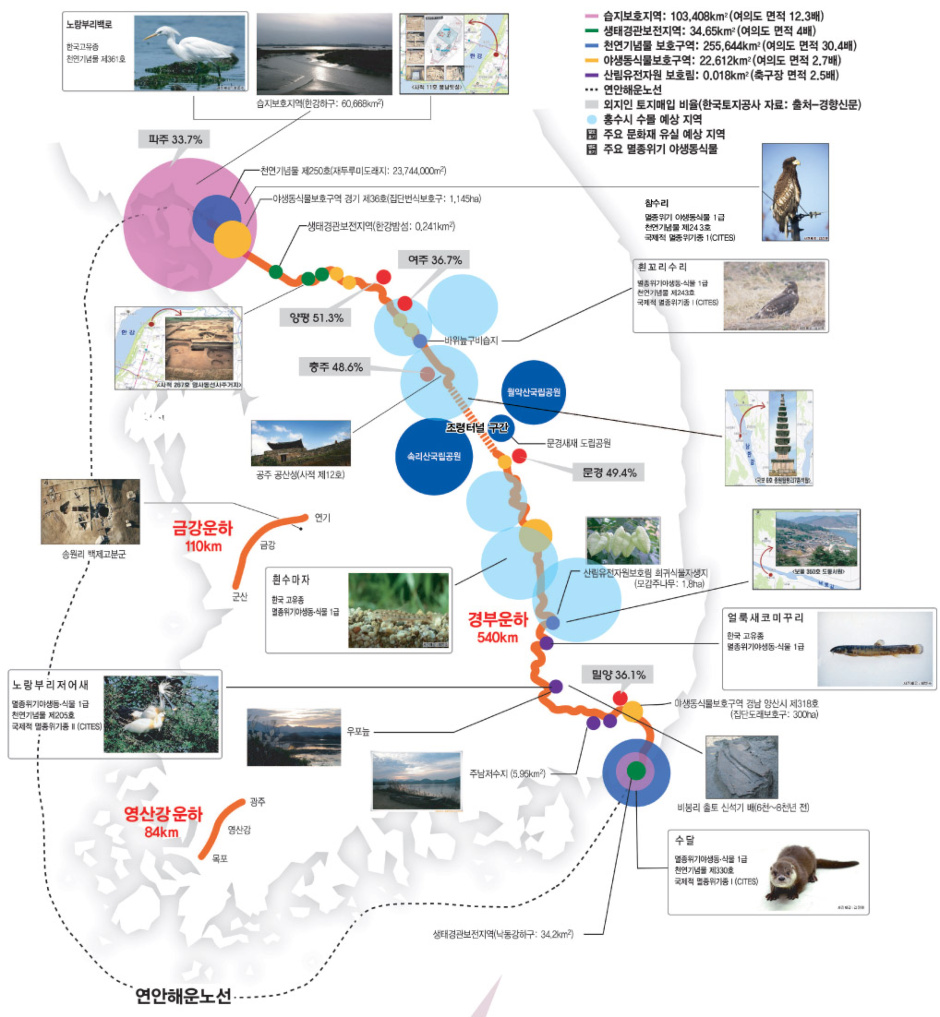
The core of the "Four River Restoration Plan" is "to increase the quantity of water retained in the Four major rivers (Han River, Nakdong River, Geum River, Yeongsan River) by dredging 570 million m3 tons of river bottom and creating 20 weirs(dams)." The plan essentially argues for enlarging and flattening river bottoms and damming up naturally flowing river systems.
Up to now dams in Korea primarily submerged upstream regions of rivers, but now the government plans to turn the entire ecosystem of the river into a massive reservoir with super dams. Such a project will turn four major rivers into a massive tub that not only will cause drinking water shortages but also destroy natural habitats for every life forms along the rivers, human or not.
(images with words "let the river runs as it is" by Baek & Jung from http://blog.daum.net/nocanal)
Everyday we protest on the street, then we learn that words are to be worthwhile to pay attention when spoken with true mind. However, we should remind that even lies could be real when repeated. That's why we say to the world "Save Our Rivers".
Next SAVE RIVERS stories will soon be uploaded as "Eight Reasons that We Oppose the Four River Restoratio Plan"
Tuesday, February 10, 2009
S.Korea Canal and River Management Project_Save Rivers News
And I put this message again with slight revision to SAVE RIVERS and their LIVES.
Friends of the Earth Korea (FOE KFEM) and lots of NGOs in Korea are campainging on the web and on the streets to figure out whether S. Korea goes “GREEN” or “GREY”. Or it will probably turn out "DARK".
Because we just hear lies disguised behind the curtain of discriminating principals.
I am doing campaigns for the conservation of intertidal mudflats and SAVE RIVERS in Korea.
These wetlands are very important habitats for the migratory birds and other species as well as local communities.
Unfortunately lots of them aren’t designated as wetland protected area and/or Ramsar sites.
Unlike the promise pronounced at the Ramsar COP10, Korean government doesn’t consider to designate Ramsar sites as their promise spoken. We only have 20 Ramsar sites!
Even worse, newly launched government is going to develop 4 big rivers with banks, dams, cycle roads, theme parks, waterway construction, etc.
“Reviving 4 River Management” and canal projects are in the rush by Lee M.B.(president) and his people. It's a shame that Ramsar COP10 venue is going to be a symbol of wetland destroyer.
They have revised and will revise Environment Impact Assessment(EIA), lowering its guidelines, so that they can excavate and pave roads even in natural reserve/protected areas, and construction will be proceed much faster, easier, unchecked. All the remaining environmental impact would be left to the wretched and helpless beings as usual.
Lots of Koreans concern that this government should lead Korean society to the past with only construction works and green-painted visions.
Even Ministry of Environment say that current river management project may clean water and prevent flood.
To accomplish this, they even named their projects as “GREEN”; Green New Deal, Green Growth.
But they just gather development projects from local governments regardless of their greenness.
They disguise themselves and pretend to be friends of the nature.
The realities will be sacrifice the of rice-paddies, farmlands, fisheries, national parks, mudflats and mountains on behalf of leisure parks, residential areas, asphalt paved creatures.
(Details will be shown on the SAVE RIVERS campaign blog(En) ASAP.)
S. Korean Government is publicize their projects on the web and on the streets; they exaggerate no living animals could be seen in the Korean rivers.
Last week, they officially campaigned on the web with video clips, even they insert one of the famous photos by American photographer Natalie Fobes to tell people that Korean rives are dead in a exaggerated way(?). After news report about its falsehood, Korean government shut down its blog for a time being.
Feel free to forward this message to Mr. Fobes whoever is acquainted with. He should know what happened with his photo.
And this video clip said:
- Korean Rivers are under quality for human use; lower than 10ppm(BOD)
- Rivers are dead with no living fish
- No natural wetlands exist in- and at- the rivers
- No birds visit Korean wetlands
- And they promise that all these creatures return alive if “Reviving 4 Rivers Management” is done; excavating 4 meters deep in the riverbed and make waterways in a straight way, and banks and dams across the river
But the true reports as follows:
- Even the worst river(Yeoungsan river) shows 5ppm(BOD) and the others show much cleaner evidence. Koreans have poured millions and billions dollars into the river.
- The photo was copied from Natalie Fobes and 2,500 salmon was killed by toxics. Though we have toxic pollutions from time to time, we still have lots of fish in the river. Just ask people on the streets whether they fish or not at the river. We have 212 different species in the different river areas. 50 species aren’t be seen in any of the world.
- Rivers themselves are natural wetlands stretching 72,533km long. It’s beyond explanation. Anyone who has visited rivers can see.
- And lots of them are on the migratory routes for cranes, shorebirds, and other birds.
- Lots of migratory birds visit and live in the Korean wetlands; estuaries, rivers, shores, sandy & rocky areas, and wherever they feel safe to breed and feed. Nakdong river itself becomes habitats for 2~4,000 migratory cranes. And estuaries are perfect places for migratory shorebirds on the coastlines.
- To make living creatures flourish in the river, just let it be. And find out the place once river has run through and rehabilitate it.
Lee M.B administration make their plans known on
webpage and portal sites(http://blog.naver.com/mltm2008, http://blog.daum.net/mltm2008).If you visit government(Ministry of Land, Transportation, and Maritime Affairs) homepage right now, you can see photos celebrating the launch of “Reviving 4 Rivers Project Team”.
Don’t be relieved that these pages are the only propagation sites for FOUR RIVER MANAGEMENT project. All the other ministries have their own websites and portal pages and blogs, too.
And even ex-politicians, who have joined Lee M.B. presidential election campaign but failed to join the National Assembly member, are actively moving to propel Canal Projects by establishing environmental NGO or institutes through the country. Though the secretary of the Bluehouse denies that they are not involved with those organizations, people knows that they prepare canal projects and propagate to help Mr. President.
So I’d like to get HELP from you and your friends about river, water, wetland management guidelines/information from overseas.
What you can help for SAVE RIVERS in S. Korea:
- If you have a good example of them, I would like to inform Korean people the better way or alternative to these BAD PROJECTS. If you have a bad and catastrophic example, let me know it to prevent Korean disaster.
- I’d like to share the real stories of Korean wetland management under this government, so that you can distribute and put the stories on your web and let it be published in/on any media. Just let me know where you have put these truth. (I have made a blog for English readers just now and it will be filled with true status of S. Korea and linked to informative websites.)
- If you have questions and more information on the blog, let us know to upload.
And if you have a few seconds, click the followers on the blog page(right) for SAVE RIVERS campaign. - If you have your own webpage and/or blog that you can receive and copy my news, let me know it on the blog or email.
- And please, distribute this news to the press or release to the readers who shall worry Endangered Wetlands/Rivers in Korea. Or forward us contacts that I and our team could release true stories of Korean wetlands.
- And if you find false stories or exaggerated news about canals and river management projects outside Korea, let me know ASAP.
Not long ago, you shall see a thorning cartoon by a famous cartoonist which shows the darkening future of Korean rivers. As soon as I translate scripts, I will put it this on the blog.
With best wishes,
Tzan
Monday, February 9, 2009
REAL stories of RIVER management in KOREA_intro
S.Korea is going to DREDGE and DEVELOP 4 big rivers in Korea under the title of "Reviving 4 Rivers" project, as Korean Grand Canal has been cornered with the objection of citizens.
Such an annoucement has been repeated several times by Lee M.B.(president) and his people to launch countrywide construction work in- and along-the river.
- Kyeongbu Canal Project
- Korea Grand Canal Project
- 4 River Management Project
- Connecting Waterway and Riverbasin Management in 4 Rivers Project
- Reviving 4 Rivers
- Reviving 4 Rivers and Riverbasin Management Project
However one thing is clear, Koreans have already poured into millions and billions dollars to water management in 4 big rivers. And 97% of rivers have already got physical treatment to control flood, pollution and watershortage.
Lee M.B. has designated every positon in the cabinet with ONE VOICE of PRO-DEVELOPMENTALIST, and they say in formal- and informal places all canals and/or construction irregardless of their ministry.
No other president has showed his career so prominetly as he. Aa CEO from construction Jaebul*. other social problems, such as labor, human right, health, education, etc.
This is S.KOREA TODAY and I will let you know more KOREAN TRUTH with river management plans, paper stories, episodes, and the like.
You won't be disappointed!
If you're pleased at my stories, forward it to your friends and make friends known where Korea goes.
Tzan
*Jaebul: a kind of plutocracy; group of big corporations which consists of family, relatives, enterprenuer, and monopolists